Art Is Not the Illustration of an Experience: It Is the Expression of an Experience in Visual Form.
Art is often discussed as though an experience occurs first and the artwork follows as an image of it. That is not how I understand making. I do not begin by asking how an event, feeling or idea might be represented. I begin within a field of attention, pressure or uncertainty, and the work develops from there. What matters is not how faithfully an experience is illustrated, but what visual form it takes through the process of making, through colour, light and structure.
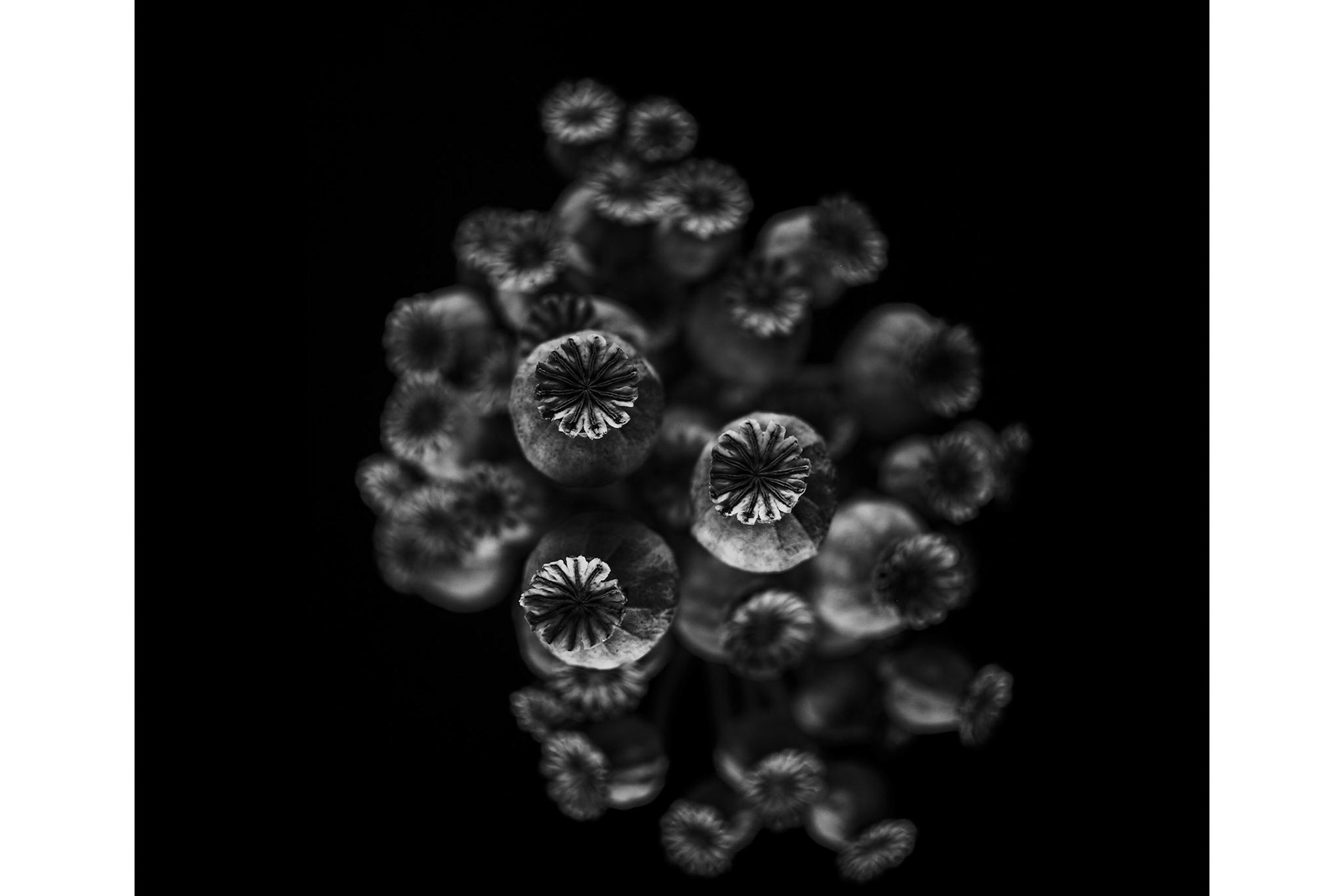
A work often begins for me with a title. It may arrive before any image exists and acts less as a caption than as a point of concentration. I do not usually intend it for display, and it is not there to tell the viewer what the finished work means. Its purpose is private and practical: to hold a thought, condition or experience in view while the work remains unresolved. In the case of Dutch Golden Poppies, the title helped establish the territory of the work, but it did not prescribe the image or explain what the finished photograph should signify.
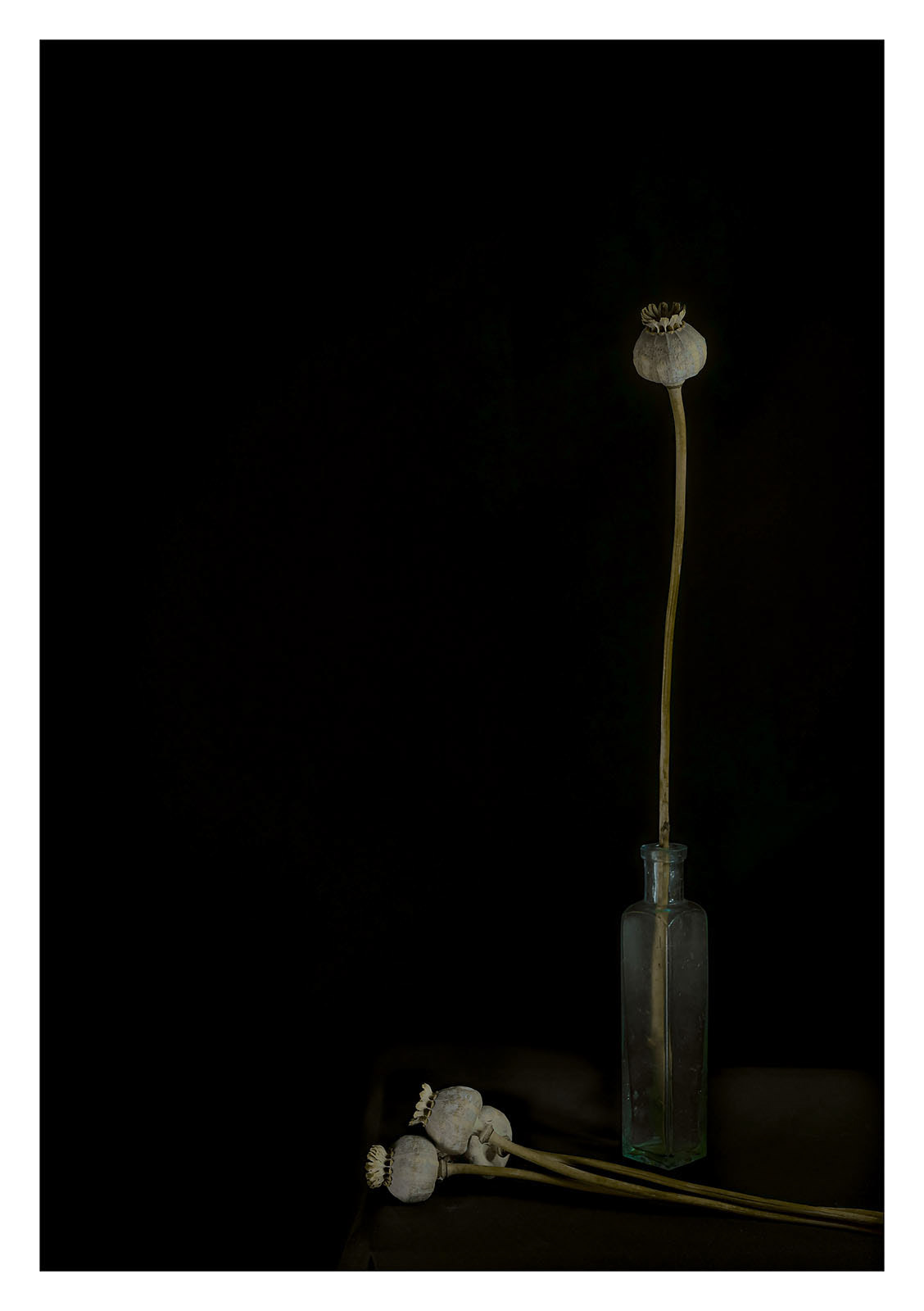
Form has to be discovered through making. I rarely begin with a complete image in mind, and I do not regard the work as the execution of an idea already settled. It develops through decisions, adjustments, failures, reversals and repetitions. A relationship between shapes, tones, colours or intervals may begin to hold and then collapse under further looking. In this photograph, the balance between the dried heads, the vase, the surrounding darkness and the restrained light was not arranged to illustrate an idea. It emerged gradually through the making of the image.
Because form is discovered in this way, frustration, duration and repetition become part of the work rather than obstacles to it. The same decision may have to be reconsidered many times; a form may seem resolved, then become doubtful again. Concentration sharpens, weakens and returns. The process is uneven, but that unevenness matters because it changes how I see the relationships within the image. The mood of the finished work depends upon this prolonged attention: on how much is revealed, how much remains in darkness, and how the elements hold together within the frame.
This prolonged attention is not passive observation. It means attending to the way an image acts: how one colour responds to another, how a form emerges from darkness, how light catches a surface, or how the spacing and weight of elements establish a mood. These relationships are not secondary qualities laid over a subject. They are the means through which the work becomes present and is experienced. Here, the muted colour of the dried heads, the tone of the vase and the slight reflections upon its surface work together to create a particular atmosphere. That atmosphere is not an idea behind the image; it arises from what is visible and from the relationships established within it.
Abstraction and photography are, for me, different means of pursuing the same aim. One begins without the obligation to describe the visible world; the other begins with what is already there. Both, however, depend upon selection, attention and the discovery of relationships. A photograph is not made expressive simply by the presence of a recognisable subject. Its force lies in the organisation of colour, light, shape, tone, interval and scale. The poppies and vase remain entirely themselves, but the image is formed through the relationships established between them.
For this reason, I resist the idea that the work should be approached as a code. A poppy is not required to stand for mortality, and darkness need not signify grief or isolation. Such associations may arise for a viewer, but they are not instructions built into the image. The work does not conceal a meaning that can be recovered by identifying its symbols. Its feeling is carried by the tension, stillness, colour, light and structure of the visual form itself.
This does not leave the work empty of meaning. Meaning arises through the encounter between the viewer and the particular organisation of the image. One person may be drawn first to its mood, another to the colour of the dried poppies, the darkness surrounding the vase, or the small points at which light becomes visible. These responses are not distractions from the work’s content; they are part of the way it is experienced. Its meaning remains open, but that openness is sustained by the precision of what has been made.
My understanding of what visual form can carry has developed through sustained attention to other artists. Turner’s treatment of light and atmosphere, Terry Frost’s use of colour and rhythm, and the differing structures found in the work of Taeuber-Arp, Riley, Rothko, Malevich, El Lissitzky, Klee and Vasarely have all enlarged my sense of what an image may do. Their importance does not lie in styles to be imitated, but in the seriousness with which they treat colour, space, movement, stillness and perception as complete forms of experience. This photograph belongs to that continuing enquiry while remaining an image of particular objects in a particular arrangement.
A work begins to feel complete when its relationships cease to appear provisional. This is not a matter of technical perfection or the removal of every uncertainty. It is a recognition that the colour, light, spacing and balance have acquired a degree of necessity, and that altering one element would change the character of the whole. Here, the fragile illumination of the vase cannot be separated from the darkness around it, nor the colour of the dried poppies from the surface against which they are seen. The image depends upon these relationships holding together.
Completion does not always bring certainty. I can remain drawn to a work while also feeling suspicious of it, particularly when it falls outside what I already know how to judge. I may question whether something necessary has been discovered or whether the image has merely become persuasive through familiarity. Such doubt is not a rejection of the work. It belongs to the discipline of looking and to the effort to distinguish between an image that is resolved and one that has simply become difficult to alter.
Time away from the work can therefore become part of its making. During the process, every passage carries the memory of the decisions and effort that produced it. After an interval, those memories begin to weaken, and the image can be encountered more nearly as a whole. What remains convincing may not be what seemed most important while I was working. Distance does not guarantee clarity, but it allows the work to establish a presence less dependent upon the circumstances of its production.
This is also why I am wary of explanations that arrive as instructions for looking. Once a viewer has been told what an image is supposed to mean, it becomes difficult to encounter it without that guidance. This essay is not intended as a key to Dutch Golden Poppies, nor as an account of what the objects within it represent. Its purpose is to describe something of the attention and process from which the work emerged. The image must still be met through its own colour, light, structure, surface and atmosphere.
This does not make intention irrelevant. The work begins within a particular field of thought and feeling, and the choices made during its construction are deliberate. But intention is not the same as a message. What I bring to the making may guide the image without determining everything the finished work can contain. Once the photograph exists, it must be capable of sustaining responses that I did not prescribe and may not have anticipated.
By expression, I do not mean the display of a feeling that existed fully formed before the work began. Nor do I mean that the objects serve as symbols for an experience located somewhere beyond the image. Expression occurs when experience is changed by the conditions of making and takes visual form. In the photograph, sustained attention is present in the measured relationship between the stems and vase, while duration and concentration are carried by the restraint of the composition. Stillness and uncertainty become qualities of light, darkness, colour and space. They are not illustrated by the image; they have become part of its form.
Visual form can hold relationships that language tends to separate. Stillness and tension can coexist; darkness can conceal and reveal; muted colour can feel both restrained and intense. These qualities cannot be reduced to a single statement because their force lies in their simultaneous presence. Words can direct attention towards aspects of an image, but they cannot reproduce the experience of seeing it. The photograph is not an imprecise version of something that could have been said more clearly. Its precision lies in the organisation of what is visible.
Making is therefore not simply the means by which an already understood experience is expressed. It is also the process through which the character of that experience becomes knowable. I may begin with a title, an atmosphere, a group of objects or a particular state of attention, but I do not yet know what form they require. That knowledge develops through arranging, lighting, photographing, editing and repeatedly returning to the image. Its character is discovered through the work rather than decided in advance.
The finished photograph is not an image of an experience that remains intact somewhere outside it. Attention, duration, resistance and choice have altered that experience and made it inseparable from the restrained light on the vase, the dried colour of the poppies, the surrounding darkness and the balance of the composition. These qualities do not point back towards something that can be fully recovered or explained elsewhere. They are the visual form the experience has taken.
This asks something of both the artist and the viewer. The artist must remain with uncertainty long enough for the work to move beyond the first intention. The viewer, in turn, must be allowed to look before being given an explanation: to encounter the image through its mood, colour, light, stillness and relationships. Dutch Golden Poppies does not conceal an experience that must be decoded. It makes that experience present in visual form.
Print Details
Title
Dutch Golden Poppies
Dutch Golden Poppies
Medium
Archival pigment print on Hahnemühle Photo Rag.
Archival pigment print on Hahnemühle Photo Rag.
Print size
A3.
A3.
Edition
Limited edition of 10, with 2 artist's proofs.
Limited edition of 10, with 2 artist's proofs.
Signature
Each print is signed and numbered by the artist in pencil.
Each print is signed and numbered by the artist in pencil.
Presentation
Supplied unframed, with a half-inch border, enclosed in acid-free archival tissue and presented in an archival print box.
Supplied unframed, with a half-inch border, enclosed in acid-free archival tissue and presented in an archival print box.
Availability
Print 2/10 is the next available edition.
Print 2/10 is the next available edition.
Price
£300 plus delivery.
£300 plus delivery.
Enquiries
If you would like to purchase this print or have any questions, please use the contact page.
If you would like to purchase this print or have any questions, please use the contact page.